Can I Refuse to Pay Resort Fees? What You Need to Know Before You Check In
 Dec, 28 2025
Resort Fee Calculator
Calculate Your True Hotel Cost
See how resort fees affect your total stay cost
Your Total Stay Cost
Tip: In many cases, these fees cover services you could access for free elsewhere or that aren't used at all.
You book a stay at what looks like a perfect all-inclusive resort. The website says "everything’s covered." But when you get to the front desk, they hand you a bill that includes a $35-per-night resort fee. You didn’t agree to this. You didn’t see it in the fine print. And now you’re wondering: Can I refuse to pay resort fees? The answer isn’t simple - but it’s not as hopeless as you might think.
What Even Is a Resort Fee?
A resort fee is a mandatory daily charge added to your hotel bill, usually between $25 and $50, even if you’re not using any of the supposed "benefits." It’s not a tax. It’s not a government fee. It’s a business decision made by the hotel - and it’s often buried in the small print during booking.
Hotels claim these fees cover things like Wi-Fi, pool access, parking, gym use, bottled water, or even local phone calls. But here’s the catch: many of these services are free elsewhere. You can get free Wi-Fi at a coffee shop. You can swim at a public beach. You can park for free on the street. So why are you being forced to pay for something you might not even use?
In the U.S., resort fees are legal - but they’re not transparent. A 2023 study by the U.S. Public Interest Research Group found that 92% of major hotel chains add resort fees, and 78% of travelers didn’t realize they’d be charged until checkout. That’s not a mistake. That’s a business model.
Why Hotels Add Resort Fees
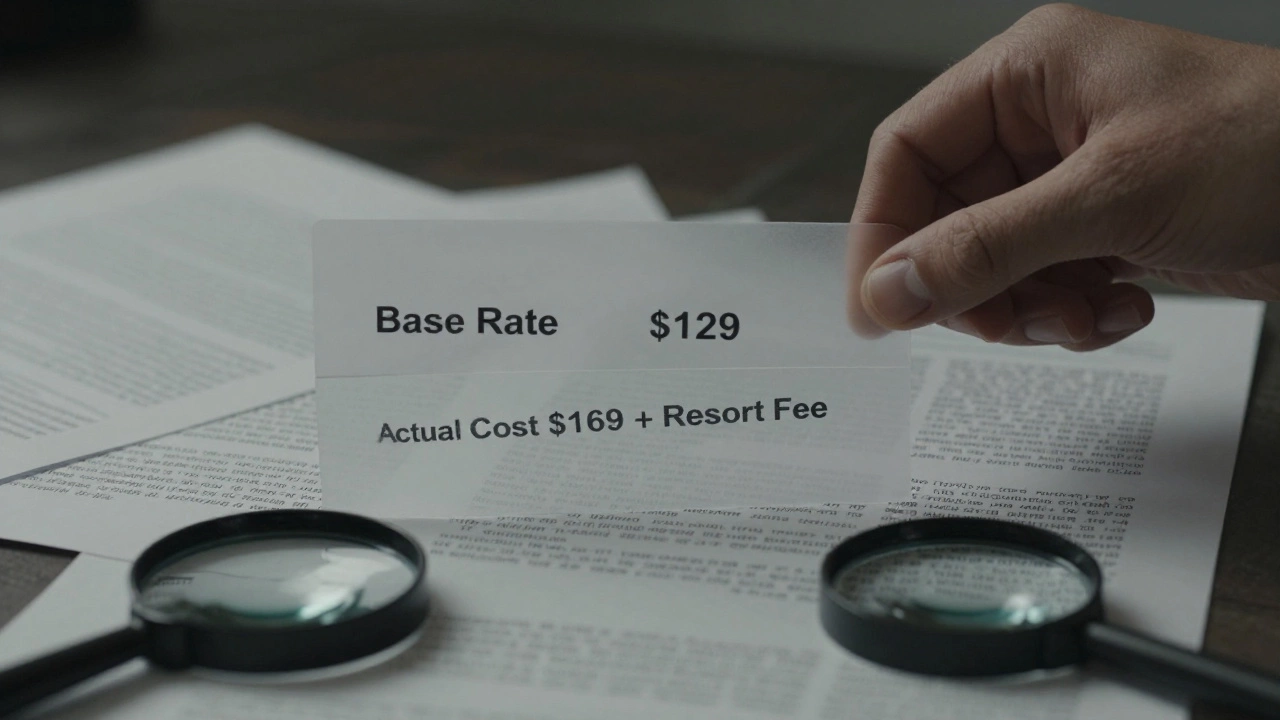
Hotels use resort fees to make their base rates look lower. You see a room advertised at $129 a night. But once you add the $40 resort fee, it’s $169. That $40 doesn’t show up in search results. It doesn’t appear in most booking engines. It hides in plain sight.
It’s a trick. And it works. Travelers compare prices based on the advertised rate, not the real one. The hotel wins. You lose.
Some resorts justify the fee by saying they offer "premium amenities." But here’s the reality: if you don’t use the spa, the fitness center, or the shuttle, you’re paying for nothing. And if you do use them, you’re paying for something you could get for free elsewhere - or even included in the room rate at a different hotel.
Can You Actually Say No?
Yes - but it’s not easy.
Legally, you are not required to pay a resort fee if it wasn’t clearly disclosed before you booked. The U.S. Federal Trade Commission (FTC) says hotels must disclose all mandatory fees upfront. If they didn’t - and you can prove it - you have grounds to refuse payment.
Here’s how to do it:
- Check your booking confirmation email. Did it mention the resort fee? If not, screenshot it.
- Go to the hotel’s official website. Did they list the fee on the room details page? If it’s buried in the terms and conditions, that’s not enough.
- At check-in, calmly say: "I didn’t see this fee listed before I booked. I’m refusing to pay it because it wasn’t disclosed upfront."
- Ask to speak to a manager. Front desk staff usually can’t override it. Managers can.
- If they push back, say: "I’m happy to pay for services I use. But I won’t pay for things I didn’t agree to."
Many travelers have successfully refused resort fees - especially if they booked through third-party sites like Expedia or Booking.com, where the fee was never shown. In 2024, the New York Attorney General’s office fined a major hotel chain $1.2 million for failing to disclose resort fees clearly.

When Refusal Won’t Work
There are times when pushing back won’t get you anywhere - and you’ll have to pay.
- You booked directly through the hotel’s website, and the fee was listed in the fine print - even if you didn’t read it.
- You’re staying at a luxury resort in a state with weak consumer protection laws.
- You’re checking in late, tired, and just want to get to your room.
Don’t let guilt or exhaustion make you pay. Even if the fee was technically disclosed, you still have rights. You can ask for a waiver - especially if you’re a loyal guest, celebrating a special occasion, or if the hotel didn’t deliver on promised amenities.
What About All-Inclusive Resorts?
This is where things get confusing. If you booked an "all-inclusive" resort, you should not be charged extra for food, drinks, or activities. But some places use "all-inclusive" as a marketing term while still slapping on resort fees.
True all-inclusive resorts - like those in Mexico, the Caribbean, or parts of Southeast Asia - include everything: meals, drinks, non-motorized water sports, nightly entertainment. No hidden fees.
If you’re in the U.S. or Europe and see "all-inclusive" paired with a resort fee, be suspicious. That’s not true all-inclusive. That’s a fee disguised as inclusion.
Check what’s actually included. If the resort fee covers Wi-Fi and parking, but you’re paying $12 for a cocktail, you’re not getting all-inclusive. You’re getting nickel-and-dimed.
How to Avoid Resort Fees Before You Book
The best way to avoid resort fees? Don’t book hotels that charge them.
Here’s how to find them:
- Use booking sites that show total price - like Google Hotels or Kayak. Filter for "all-inclusive" or "no resort fees" if available.
- Check the hotel’s official website. Look for "mandatory fees" in the terms or FAQ section.
- Search for the hotel name + "resort fee" in Google. If people are complaining about it, you’ll know.
- Call the hotel directly and ask: "Is there a mandatory daily resort fee?" Record the date and time of the call, and the name of the person you spoke to.
- Book with hotels that don’t charge them. Many independent hotels, boutique properties, and even some chains like Hyatt and IHG (in certain locations) don’t add resort fees.
There are hotels that charge nothing extra. They just include everything in the price. You don’t have to pay for the privilege of using your own room’s Wi-Fi.
What to Do If They Still Charge You
If you paid the fee under pressure, don’t give up.
- Call the hotel within 48 hours of checkout and ask for a refund. Say: "I was not informed of this fee before booking. I’d like a refund as it violates disclosure rules."
- If they refuse, file a dispute with your credit card company. Use the FTC’s guidelines on undisclosed fees as your argument.
- Leave a detailed review on Google, TripAdvisor, and Trustpilot. Mention the fee and how it was hidden. Other travelers will thank you.
- Report the hotel to your state’s attorney general or consumer protection agency. In the U.S., many states have active enforcement programs.
One traveler in Florida successfully got a $300 refund after disputing three nights of $40 resort fees. She kept copies of her booking confirmation, the hotel’s website, and her credit card statement. She didn’t yell. She didn’t threaten. She just stuck to the facts.
Bottom Line: You Have Power
Resort fees aren’t illegal. But they’re often deceptive. And you don’t have to accept them.
You have the right to know what you’re paying for before you commit. You have the right to refuse to pay for services you didn’t agree to. And you have the right to speak up - not just for yourself, but for every traveler who comes after you.
Next time you book a hotel, ask: "Is there a resort fee?" If they hesitate - walk away. There are plenty of places that don’t hide their prices. You deserve to know the real cost before you arrive.