What Age Is Considered a Child for Hotels? Family Policies Explained
 Mar, 16 2026
Hotel Child Policy Checker
Find out if your child qualifies for child rates at major hotel chains based on their age
When you’re planning a family trip, one of the first questions that pops up is: what age is considered a child for hotels? It seems simple, but the answer isn’t the same everywhere. One hotel might let your 12-year-old stay free, while another charges you full price for a 10-year-old. This isn’t just about saving money - it’s about knowing what to expect so you don’t get caught off guard at check-in.
There’s No Global Standard
Unlike airlines, which have fairly consistent rules (usually under 12 or 13), hotels set their own child age limits. There’s no international law, no government agency that says, "A child is anyone under 12." Instead, each hotel chain - even each property - decides for itself.
For example, Marriott International generally considers children under 18 to be eligible for child rates at most of its brands. But a boutique resort in Bali might only offer free stays for kids under 5. Meanwhile, a family resort in Orlando might let teens up to 16 stay for free if they share a room with adults.
This lack of standardization is why you can’t assume anything. Always check the fine print - or better yet, call the hotel directly. Don’t rely on third-party booking sites. They often list generic policies that may not reflect the actual property’s rules.
What You’ll Typically Find
Most hotels group children into three categories:
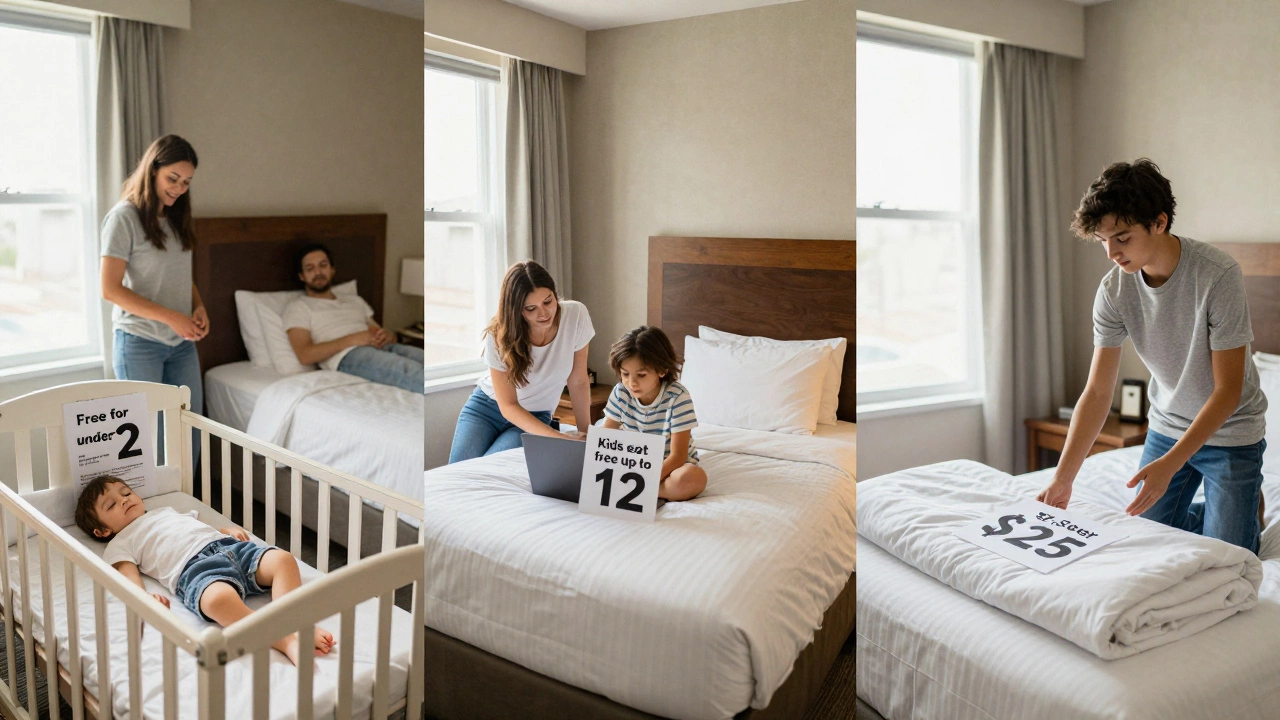
- Infants (0-2 years): Almost always free. They don’t need a separate bed, and most hotels provide cribs at no cost.
- Young children (3-11 years): This is the sweet spot for discounts. Many hotels offer 50% off or free stays for kids in this range, especially if they sleep in the same bed as parents.
- Teens (12-17 years): This is where things get tricky. Some hotels still treat teens as children. Others charge adult rates. A few charge a flat fee for extra bedding or meals.
Let’s look at real examples from 2026:
- Holiday Inn Club Vacations: Kids 17 and under stay free when sharing a room with two adults.
- Best Western: Children 12 and under stay free in parent’s room.
- Disney Resorts: Kids under 18 get free meals and room stays if sharing a room with adults - a rare exception that’s built into their family-focused model.
- Four Seasons: Children under 12 stay free; teens 13-17 are charged 50% of the adult rate.
Notice how the cutoff shifts between 12 and 18? That’s because hotels aren’t just thinking about space - they’re thinking about meals, amenities, and liability.
Why Do Hotels Care About Age?
It’s not just about being nice to families. There’s a business side too.
Hotels charge for extra beds, breakfasts, and sometimes even pool access. If a 14-year-old is treated as a child, they might get free breakfast. If they’re treated as an adult, you’re paying $15 just for toast and eggs. Multiply that by three kids and a weekend stay - suddenly you’re looking at $180 extra.
Also, many hotels have policies tied to occupancy limits. A standard room might allow two adults and one child. Add a 16-year-old and suddenly you’re over the limit. That’s why some places ask for ages at booking - not to be nosy, but to avoid overbooking.
And don’t forget about safety. Pool rules, spa access, and even late-night elevator use can be restricted based on age. A 15-year-old might need a parent to sign a waiver just to use the hot tub.
What About Breakfast?
This is one of the biggest surprises for families. Many hotels include breakfast in the rate - but only for certain ages.
At a typical mid-range hotel, breakfast might be free for kids under 12. At a luxury property, it could be under 6. And some places charge per child, no matter the age.
Here’s what to look for:
- "Free breakfast for children" - always check the age limit.
- "Complimentary meals for kids" - this often means buffet-style only, and sometimes only at certain times.
- "Kids eat free with adult purchase" - common in resorts. One adult buys a meal, and one child gets one free.
At a hotel in Queenstown last year, a guest paid $22 for their 13-year-old’s breakfast because the policy said "free for under 12." They didn’t realize the rule until they were at the buffet line. Don’t let that be you.
How to Avoid Surprises
Here’s how to make sure you’re not overcharged:
- Check the hotel’s official website. Look for "Family Policies," "Child Rates," or "Occupancy Guidelines."
- Call the front desk. Ask: "What’s your policy for children under 18? Does the age limit apply to room rates, meals, or both?"
- Book directly. Third-party sites often hide or misstate child policies. Booking through the hotel’s site gives you the most accurate info.
- Ask about extra beds. Some hotels charge for rollaway beds even if the child is under the free age limit.
- Confirm at check-in. Sometimes policies change last-minute due to events or renovations. Get it in writing.
Pro tip: Keep a screenshot of the policy page from the hotel’s official site. If there’s a dispute at check-in, you can show it to the manager.
What If Your Child Is Right on the Edge?
What if your child turns 12 the day after your trip? Or they’re 17 but still in high school? Some hotels are flexible.
One family in Nelson, New Zealand, called ahead and explained their 17-year-old was still in secondary school. The hotel manager, impressed by their honesty, let them keep the child rate - even though the official policy said 16 and under.
It’s not guaranteed, but polite, clear communication can make a difference. Don’t assume they’ll bend the rules - but don’t assume they won’t either.

Special Cases: All-Inclusive Resorts and Cruises
All-inclusive resorts often have looser rules. Many include kids under 18 in the package - meals, drinks, activities. But check the fine print. Some charge for teens at premium bars or spa access.
On cruise lines, the rules are even more varied. Carnival Cruise Line treats kids as under 18 for pricing. Royal Caribbean goes up to 17. But if you’re booking a cabin with a balcony, they might charge for a third occupant no matter the age.
The takeaway? Always compare policies side by side. A resort that says "kids stay free" might still charge $25 per day for activities. A hotel that charges $30 for a teen might include unlimited mini-golf and movie nights.
What’s Changing in 2026?
More hotels are moving toward flexible policies. After the pandemic, family travel rebounded strongly. Chains like Hilton and Hyatt now offer "Family Add-On" packages that let you add a teen for a flat $15 fee - no matter the age.
Some are even dropping age limits entirely. A new group of eco-lodges in Costa Rica and New Zealand now allow all children under 21 to stay free if sharing a room. It’s still rare, but it’s growing.
What’s driving this? Data. Hotels that track guest behavior found that families with teens spend more on extras - snacks, souvenirs, guided tours - than those with younger kids. So they’re designing policies to keep them happy.
Final Rule: Always Confirm
There’s no single answer to "What age is considered a child for hotels?" It depends on the hotel, the region, the brand, and sometimes even the season.
Don’t guess. Don’t assume. Don’t wait until check-in.
When you’re booking, make a habit of asking: "What’s your child age policy for room rates and meals?" Write it down. Save the email. That one step could save you $200 - and a whole lot of stress.
Is a 16-year-old considered a child at most hotels?
It depends. Many hotels still consider 16-year-olds as children for room rates, especially in family-focused chains like Holiday Inn or Disney resorts. But luxury hotels and urban properties often charge adult rates starting at age 12 or 13. Always check the specific hotel’s policy - there’s no universal rule.
Do hotels charge for extra beds for children?
Yes, sometimes - even if the child stays free. Many hotels charge $15-$30 per night for a rollaway bed or cot, regardless of age. Some include it in the child rate, others don’t. Always ask if the free stay includes bedding.
Can I get a discount if my child is 18 but still in school?
It’s unlikely. Most hotels use age, not school status, to determine child rates. An 18-year-old is legally an adult in most countries, so they’ll be charged as such. But some resorts offer student discounts - it’s worth asking.
Are there hotels that don’t charge for kids at all?
Yes. Family resorts, especially in the U.S., Caribbean, and parts of New Zealand, often allow unlimited children under 18 to stay free. Examples include Club Med, all-inclusive properties in Cancun, and some boutique lodges in Queenstown. Always verify the policy - some require two paying adults.
Why do some hotels charge more for teens than for toddlers?
Because teens eat more, use more amenities, and often need a separate bed. A toddler might sleep in a crib and not touch the minibar. A 15-year-old might eat three meals, use the pool, and want a snack at midnight. Hotels price based on usage, not just age.